
For years, discussions around artificial intelligence in customer service have focused heavily on automation and workforce reduction. But the latest Gartner research tells a very different story.
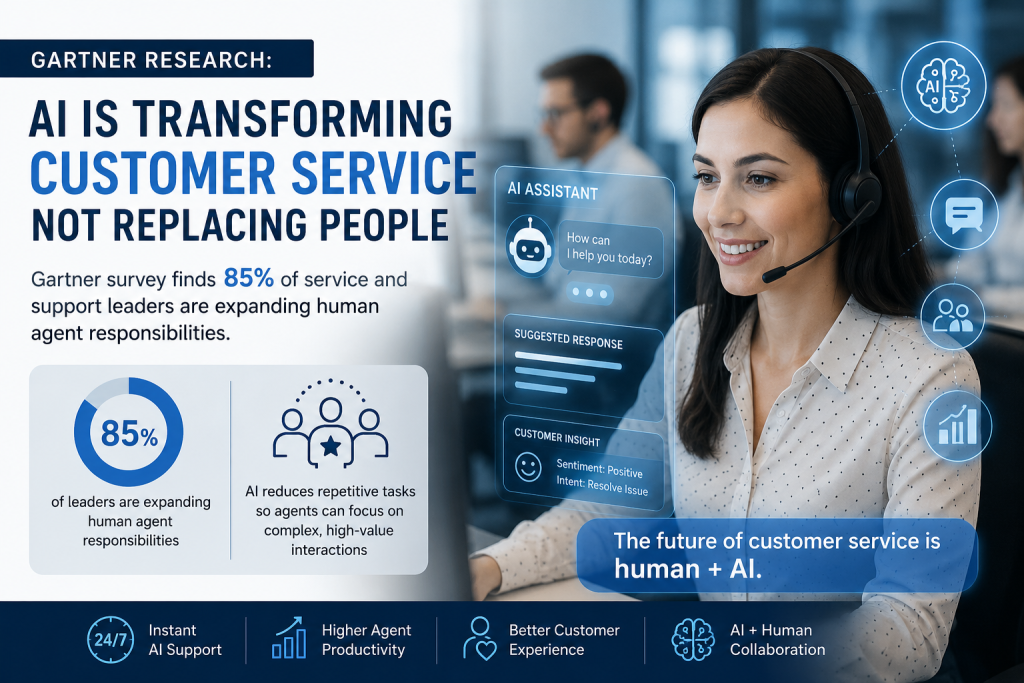
According to a recent Gartner survey, 85% of customer service and support leaders are actually expanding human agent responsibilities as AI reduces repetitive interactions and shifts work toward higher-value tasks.
The findings confirm what many forward-thinking organizations are already experiencing: conversational AI is not eliminating the human workforce, it is redefining and elevating it.
AI Is Changing the Nature of Customer Service
Modern conversational AI technologies are transforming contact centers faster than ever before.
From AI chatbots and voice assistants to real-time agent copilots and automated quality management systems, AI is helping organizations:
- Handle growing customer demands
- Reduce response times
- Improve service consistency
- Increase operational efficiency
- Deliver more personalized customer experiences
At the same time, customer expectations continue to rise. Consumers now expect immediate, intelligent, and seamless support across every communication channel.
This is where conversational AI delivers significant value.
Unlike traditional rule-based automation, modern AI systems use:
- Natural Language Processing (NLP)
- Machine Learning
- Generative AI
- Sentiment analysis
- Context-aware conversation capabilities
These technologies allow businesses to automate repetitive interactions while enabling human agents to focus on more complex, emotional, and business-critical conversations.
Gartner Findings Reveal a Major Industry Shift
The newest Gartner survey highlights an important change in how organizations approach AI adoption in customer service.
Rather than replacing agents entirely, most organizations are redesigning roles and workflows around AI augmentation.
The research found that:
- 85% of service leaders are adding new responsibilities to frontline agents
- 75% are moving agents into entirely new service and support roles
- 80% of leaders report pressure to redesign their workforce because of AI-driven efficiency improvements
This reflects a broader industry realization: AI performs best when it works alongside people, not instead of them.
As routine customer inquiries become automated, human agents increasingly handle:
- Complex problem-solving
- Escalation management
- Emotional customer interactions
- Relationship-building
- Revenue-generating conversations
- Cross-functional support activities
In other words, AI is elevating customer service roles into more strategic positions.
The Rise of the AI-Augmented Agent
One of the biggest misconceptions surrounding AI is that automation automatically removes the need for human employees.
In reality, successful organizations are investing heavily in AI-assisted employees rather than fully autonomous operations.
Modern AI-powered contact centers now provide agents with:
- Real-time response suggestions
- Automated conversation summaries
- Live sentiment analysis
- Instant knowledge recommendations
- Smart routing and prioritization
- Predictive customer insights
Research consistently shows that these capabilities significantly improve productivity and customer satisfaction.
The future contact center agent will require a combination of:
- Emotional intelligence
- Technical adaptability
- AI collaboration skills
- Critical thinking
- Data interpretation
Gartner emphasizes that future customer service agents will need to balance human empathy with AI-powered efficiency.
Why Human Interaction Still Matters
Despite rapid AI adoption, businesses are discovering clear limitations to fully automated customer experiences.
Customers still prefer human interaction in situations involving:
- Emotional sensitivity
- Complex decision-making
- Complaints and escalations
- High-value purchases
- Trust-building conversations
This is why smooth AI-to-human handoffs are becoming one of the most important success factors in modern customer experience strategies.
Organizations that combine:
- intelligent automation,
- proactive AI engagement,
- and highly skilled human agents
are achieving the strongest customer experience outcomes.
The goal is no longer to build “humanless” service operations.
The goal is to create AI-enhanced service organizations where technology amplifies human capabilities.
AI Adoption Requires More Than Technology
Another major lesson emerging from the market is that successful AI implementation depends heavily on organizational readiness.
Businesses that achieve strong AI outcomes are investing in:
- Employee training
- Workflow redesign
- Knowledge management
- Governance frameworks
- Data quality
- Change management
According to Gartner and multiple industry analysts, organizations focused only on cost-cutting often struggle to realize long-term AI value.
AI is not simply a software deployment project.
It is an operational transformation initiative.
The Future of Customer Experience Is Human + AI
The next generation of customer service will not be fully human or fully automated.
It will be collaborative.
AI will continue taking over repetitive and transactional interactions, while human agents will focus on:
- empathy,
- judgment,
- creativity,
- relationship management,
- and strategic customer engagement.
Organizations that understand this balance early will gain significant advantages in customer satisfaction, operational efficiency, and long-term competitiveness.
The latest Gartner findings reinforce a message that is becoming increasingly clear across the industry:
AI is not replacing customer service teams.
It is transforming them into higher-value, more strategic functions.
At Algotech, we help organizations modernize customer communication through advanced contact center, conversational AI, automation, and digital transformation solutions designed for the future of customer experience.